and the research scholar Jayashree Baburao Deshmanya made the discovery during the course of their research on Buddhist remains in the district.
A few kilometres away from Tunnur village, archaeologists had found a Buddhist site near the pilgrimage town of Sannati more than a decade ago. Later, the Archaeological Survey of India (ASI) declared it a protected national monument and took up excavation and reconstruction work.
During the excavation, archaeologists recovered priceless artefacts and terracotta items revealing the influence of Buddhism in the region. According to Dr. Shadaksharaiah, the research team found artefacts dating back to many centuries and most of the sculptural panels found were scattered in a radius of about 1 km.
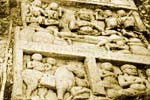
Some of the panels recovered included one depicting Mandoka Jataka story, Dharmachakra, a piece of stupa fence, and two types of memorial stones. In the Mandoka Jataka story panel the figures of a queen, Amatya, pattada horse, and pattada elephant are clearly visible, and the panel is quite similar to the one recovered from Hampi in Bellary district.
Research scholars during the course of their work found two distinct memorials. One of them belonged to the king and the royal members and another to the common people. In the former, there are figures of a horse, servants of the royal family, and king and queen seated and holding goblets.
Some of the memorials bear labels with inscriptions in Brahmi script and Prakrit language. One of them reads: "Valavasa Papalana Kanhasa." Kanhasa means Krishna.
The panels are made on limestone. |